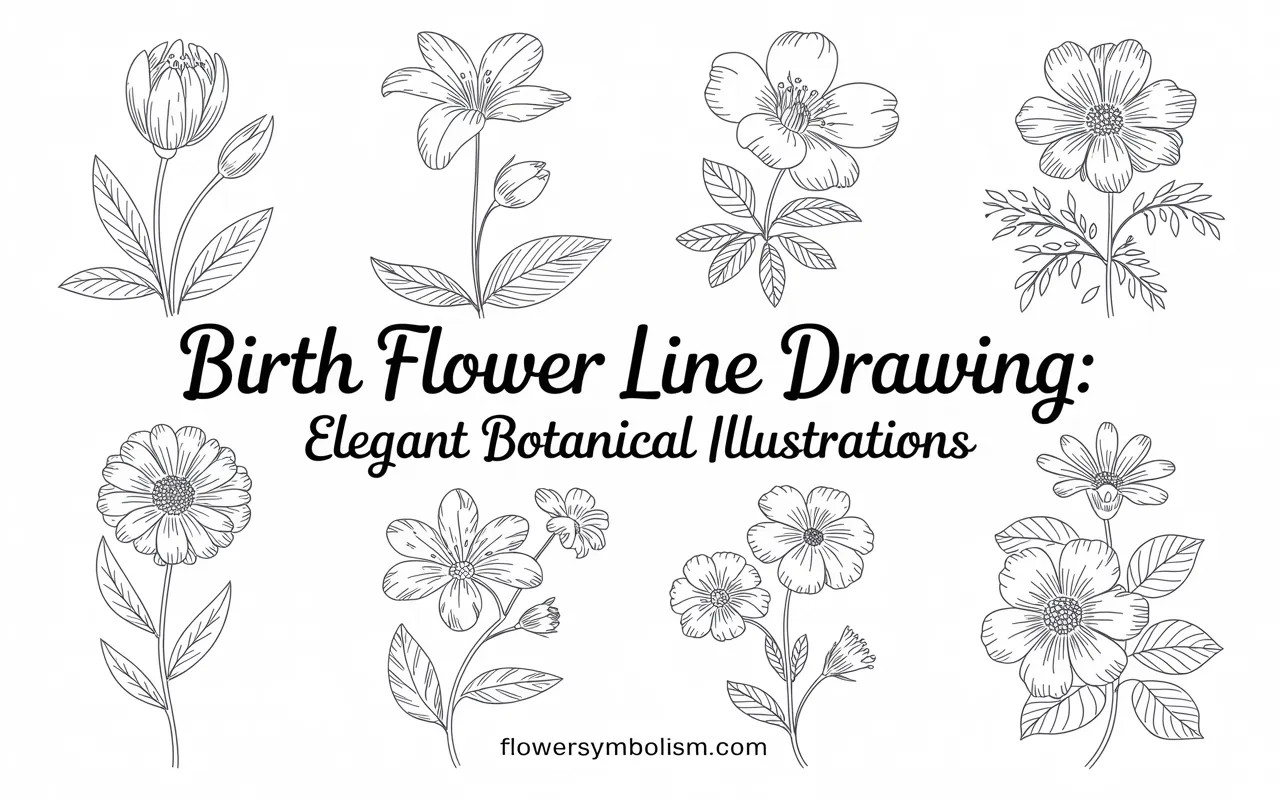
There is a profound beauty in simplicity. In a world full of noise and color, a single, clean line can speak volumes.
This is the magic of line drawing, an art form that strips away everything but the essential form. When applied to the personal and symbolic world of birth flowers, the result is pure elegance.
A birth flower line drawing is a sophisticated, modern, and deeply meaningful way to connect with the botanical emblem of your birth month.
Line drawing is an accessible art form for everyone. It doesn’t require expensive paints or complex techniques.
All you need is a pen and paper to begin translating the natural world into a graceful, minimalist illustration.
This practice is not just about creating art; it’s a meditative exercise in observation, teaching you to see the true shape of a petal, the curve of a stem, and the delicate structure that gives each flower its unique character.
This guide will walk you through the beauty of the birth flower line drawing for each month of the year.
We’ll explore how to capture the essence of each bloom with just a few simple lines, offering inspiration for your own creative projects, tattoo designs, or heartfelt, handmade gifts.

The Grace of Simplicity: Why Choose Line Drawing?
Before we begin our journey through the year, let’s appreciate what makes this artistic style so captivating. A birth flower line drawing distills a flower down to its purest identity.
- Focus on Form: Without color or shading, the unique silhouette and structure of the flower become the main event. You learn to truly appreciate the graphic shape of a daffodil’s trumpet or the ruffled edge of a carnation’s petal.
- Minimalist Aesthetic: Line art has a modern, chic, and timeless appeal. It fits beautifully with minimalist decor and design sensibilities.
- Beginner-Friendly: This style is one of the most accessible ways to start drawing. It builds confidence by focusing on one element at a time—the line.
- Versatile Application: These simple drawings are perfect for a wide range of uses, from greeting cards and stationery to embroidery patterns and, most popularly, elegant tattoo designs.
The process of creating a birth flower line drawing is as beautiful as the result. It’s a quiet moment of focus, where you and the flower exist in a world of simple, elegant lines.
January: The Carnation
Symbolism: Love, distinction, resilience.
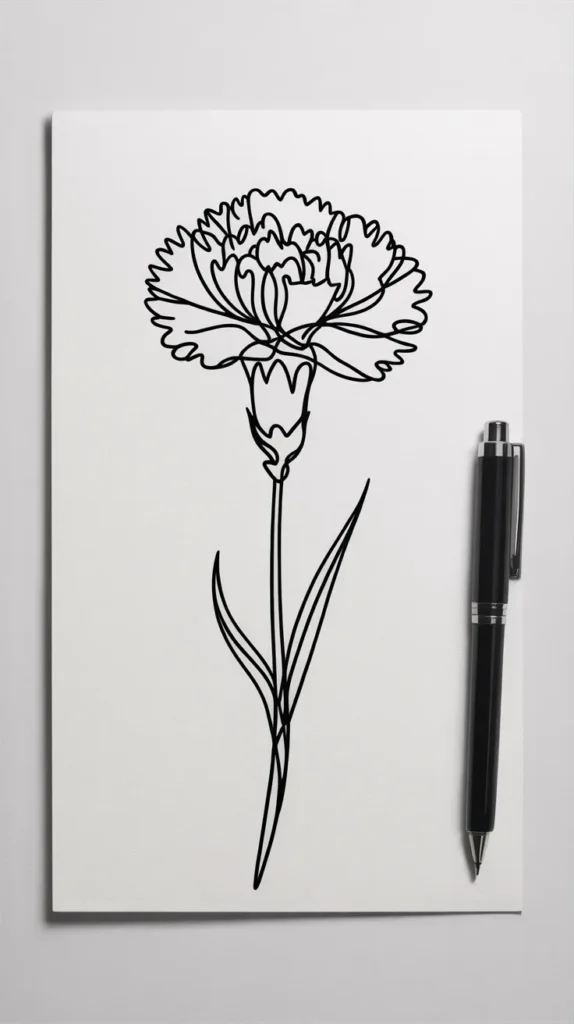
The carnation’s challenge lies in its densely packed, ruffled petals. In line drawing, the goal isn’t to draw every single ruffle but to suggest that texture with a few clever, wavy lines.
- How to Draw It: Start with a light pencil sketch of the overall round shape. Then, begin in the center, drawing a few small, tight, wavy lines to represent the heart of the bloom.
Work your way outwards, adding larger, looser, C-shaped wavy lines to build up the layers of petals. Use a continuous, flowing line where possible to give it an organic feel.
Don’t forget a few simple lines for the calyx (the green part at the base) and the straight stem.
A high-quality set of fine-liners like the {Sakura Pigma Micron Pen Set} is perfect for this, as it offers various tip sizes to control your line weight.
February: The Violet
Symbolism: Modesty, wisdom, faithfulness.
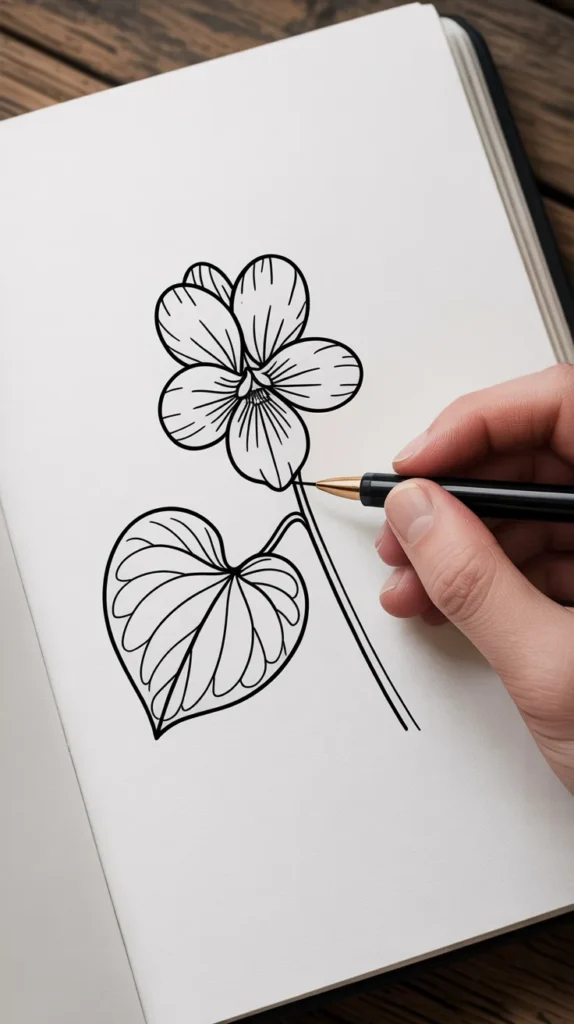
The sweet, simple violet is a wonderful subject for a beginner. Its distinct, five-petaled shape and heart-shaped leaves are easy to identify and capture.
- How to Draw It: A violet is made of two upper petals and three lower petals. Start by drawing the two top petals, which often look a bit like a butterfly’s wings. Then add the three lower petals, with the bottom-most one often being slightly larger.
Connect them to a delicate, curved stem. For the leaves, focus on their characteristic heart shape, adding a simple line or two for the veins. Drawing a small cluster of three or four violets together creates a lovely composition.
March: The Daffodil
Symbolism: New beginnings, joy, rebirth.
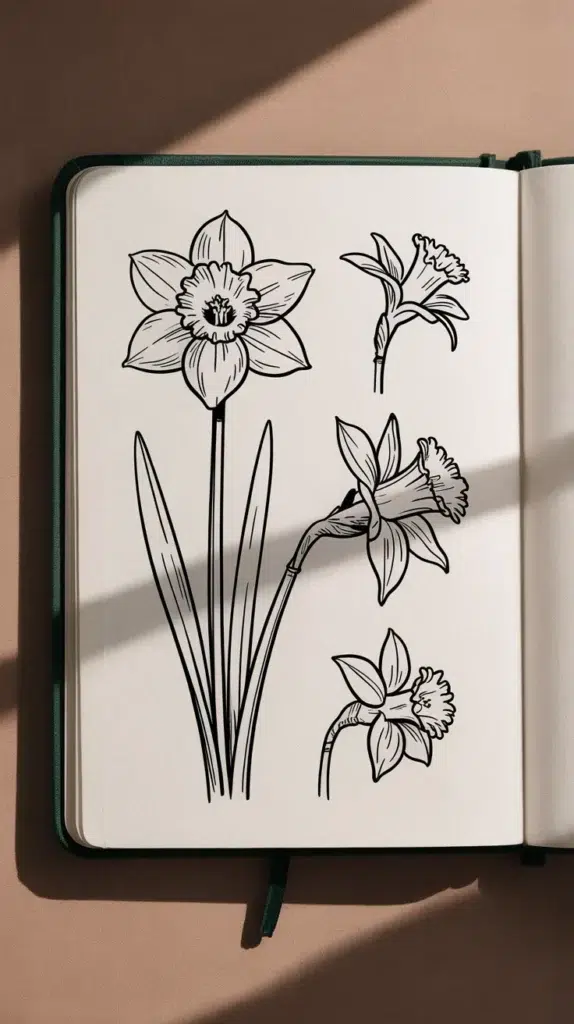
The daffodil is all about its iconic form: the six outer petals and the central trumpet. Capturing this three-dimensional shape with simple lines is a fun and rewarding challenge.
- How to Draw It: Begin by drawing the six outer petals, which form a star-like shape. Think of it as two overlapping triangles. Next, draw the central trumpet.
From the side, it’s a simple cup shape with a wavy, ruffled edge. From the front, it’s a circle with a frilly line. A birth flower line drawing of a daffodil in profile is particularly elegant, showing off its unique silhouette.
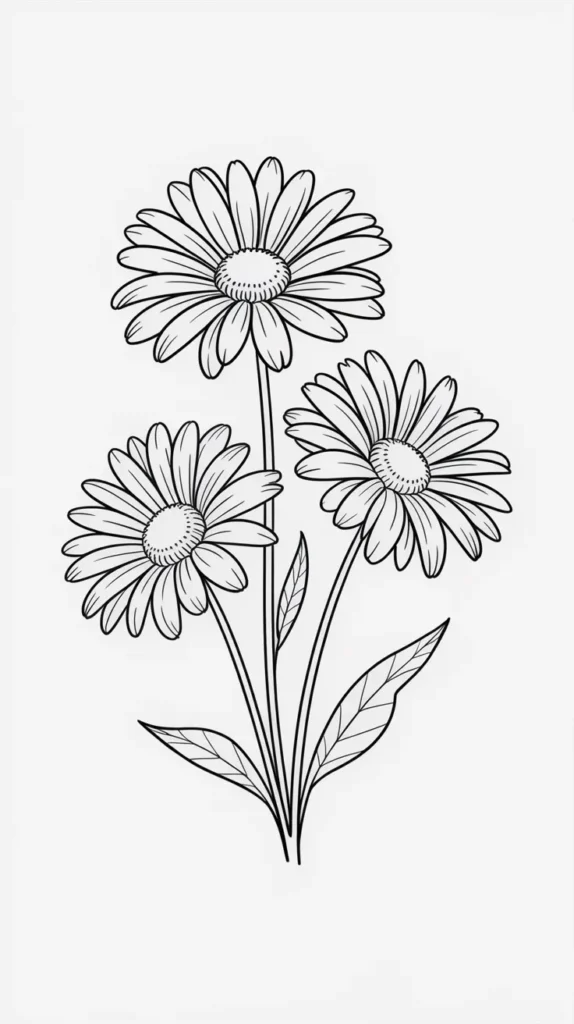
April: The Daisy
Symbolism: Innocence, purity, true love.
The daisy is the quintessential flower of simplicity. Its beauty is in the perfect, radiating symmetry of its long, slender petals around a circular center.
- How to Draw It: Start by drawing the circular center. Then, begin adding the long, oval-shaped petals around it.
Don’t worry about making them all perfectly identical; slight variations in size and angle will make your drawing look more natural. For a classic birth flower line drawing, focus on creating clean, confident lines for each petal.
You can draw just the bloom or add a long, simple stem. To practice getting your lines smooth, sketching on quality paper from a {Canson XL Series Mix Media Pad} can make a huge difference.
May: The Lily of the Valley
Symbolism: Sweetness, motherhood, humility.
This delicate flower presents a lovely challenge with its arching stem and series of tiny, hanging, bell-shaped flowers. The key to this drawing is capturing the sense of weight and grace.
- How to Draw It: First, draw the main, arching stem. This single line is the backbone of your drawing. Then, from this main stem, draw the smaller, delicate stalks (pedicels) that hold the flowers. At the end of each of these, draw the bell shape.
Think of it as a small “U” shape with a slightly flared, wavy opening. Add the long, spear-like leaves at the base to complete your drawing.

June: The Rose
Symbolism: Love, beauty, devotion.
The rose, with its spiraling layers of petals, can seem complex. The secret to a successful line drawing is to simplify and suggest, rather than trying to draw every single petal.
- How to Draw It: Start in the center with a small, tight spiral. This is the heart of the rosebud. Working outwards, add larger, C-shaped and S-shaped lines that cup this central spiral. These lines represent the larger petals unfurling. Let the lines overlap and interact.
The final shape should feel like a beautiful, controlled scribble. Add a stem and a few characteristic serrated leaves to finish your elegant birth flower line drawing.

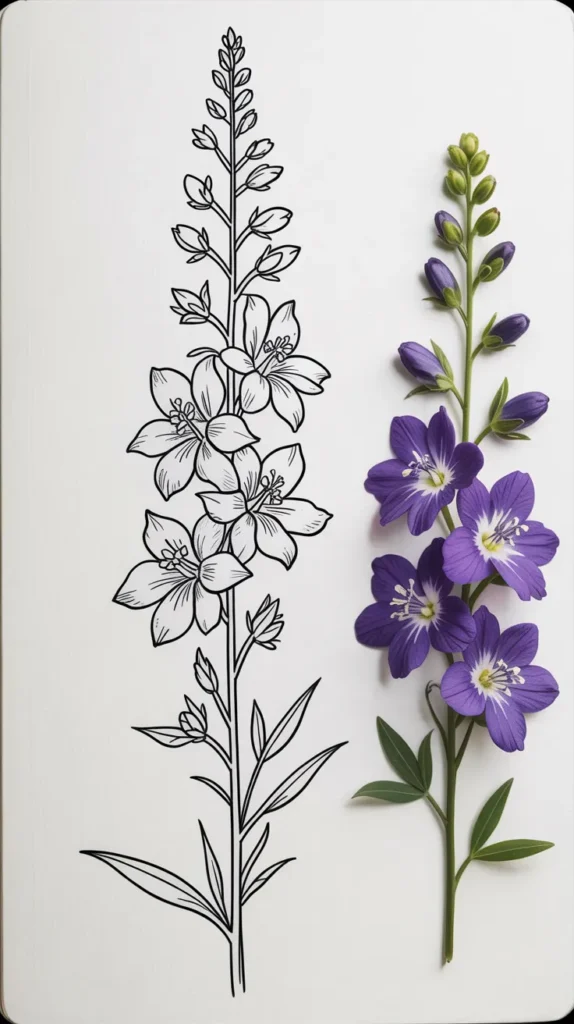
July: The Larkspur
Symbolism: Lightness, open heart, levity.
The tall, elegant larkspur is defined by its verticality and its clusters of small, uniquely shaped blooms. In line art, it creates a wonderfully graceful and decorative image.
- How to Draw It: Begin by drawing the long, slender main stem. This will be the central axis of your drawing.
The individual larkspur flowers have a complex shape, almost like a little bonnet or a dolphin. You can simplify this into a main rounded shape with a small “spur” at the back.
Draw these shapes in clusters up the stem. Add some fine, feathery leaves at the base to complete the look. The final drawing should have a light, airy feel.
August: The Gladiolus
Symbolism: Strength of character, integrity, honor.
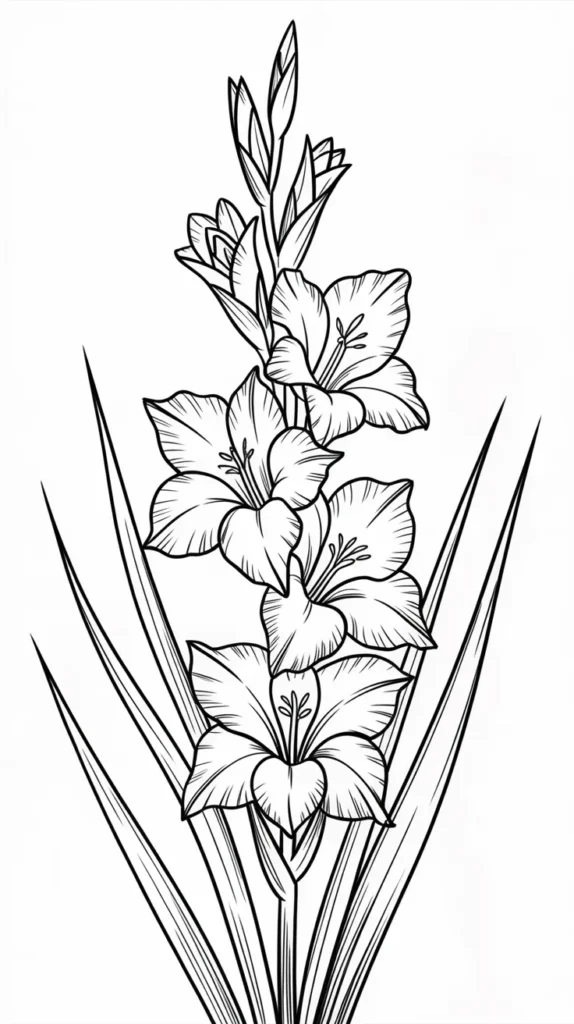
The gladiolus is a powerful and dramatic flower. Its name comes from the Latin for “sword,” and its shape reflects that. The large, open-faced blooms grow up a thick, strong stalk.
- How to Draw It: Draw the thick, straight stalk first. The gladiolus blooms are large and often have ruffled edges.
You can draw them as a series of open, wavy, cup-like shapes that ascend the stalk. They often face in one primary direction. Overlap the petals to create a sense of depth. Below the blooms, add the long, sword-shaped leaves.
A birth flower line drawing of a gladiolus should feel strong and proud. To get those confident lines, practicing with a good set of drawing pencils like the {Derwent Graphic Drawing Pencils} can help build a steady hand before you commit to ink.
September: The Aster
Symbolism: Wisdom, valor, faith.
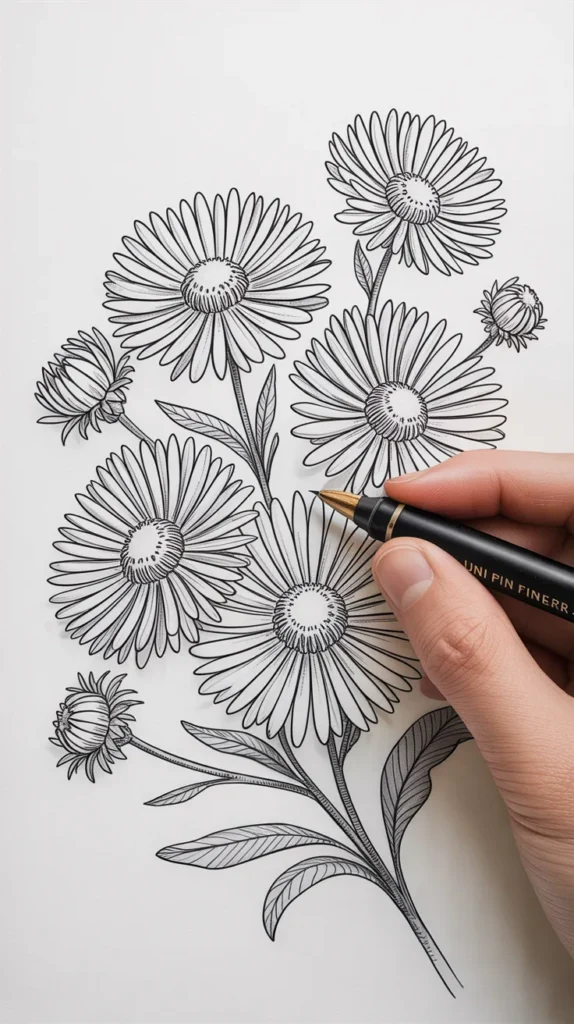
The aster is a lovely, star-shaped wildflower. Its name even means “star.” It features a round, button-like center surrounded by many fine, slender petals, giving it a cheerful and slightly chaotic look.
- How to Draw It: Start with the circular center. Unlike a daisy, an aster’s center is often drawn with a dense collection of tiny circles or dots to suggest its texture. Then, draw the many fine, pointed petals radiating outwards.
They don’t need to be perfectly symmetrical. In fact, a little bit of randomness in their length and direction will make your birth flower line drawing look more natural and wild.
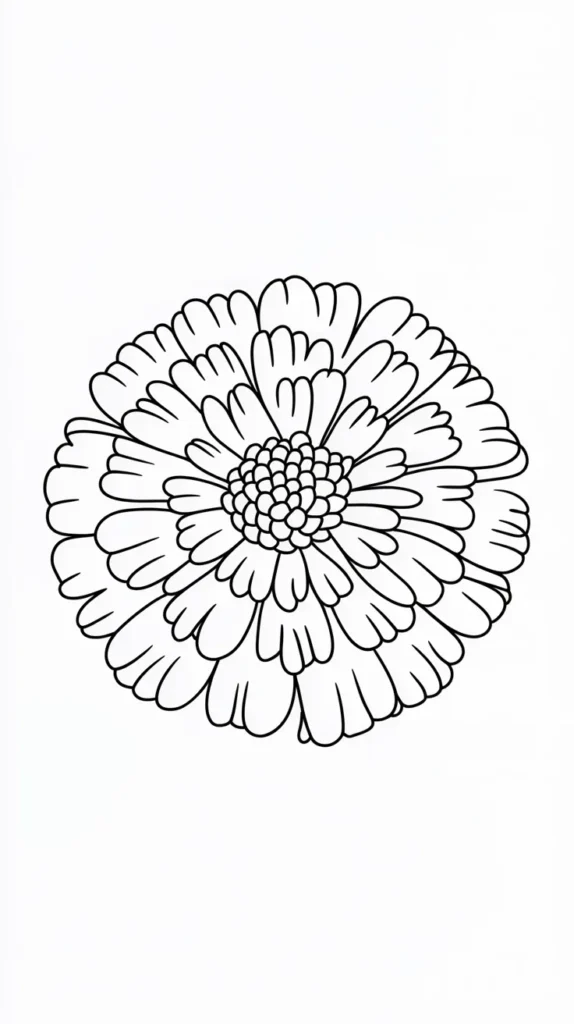
October: The Marigold
Symbolism: Creativity, passion, fierce love.
The marigold, especially the French Marigold, is another flower with a dense, ruffled appearance. Its round, pom-pom shape is its most defining characteristic.
- How to Draw It: Similar to the carnation, the key is to suggest texture. Start with a circular outline. Fill this circle with wavy, scalloped lines that overlap and curve.
Think of it like drawing clouds or waves packed tightly together. For the stem, add the distinctive, feathery leaves. A line drawing of a marigold can be a beautiful, abstract pattern of flowing lines.
A good quality digital drawing tablet like the {Wacom Intuos Graphics Drawing Tablet} can be great for this, as the “undo” function allows for fearless experimentation with complex patterns.
November: The Chrysanthemum
Symbolism: Joy, friendship, longevity.
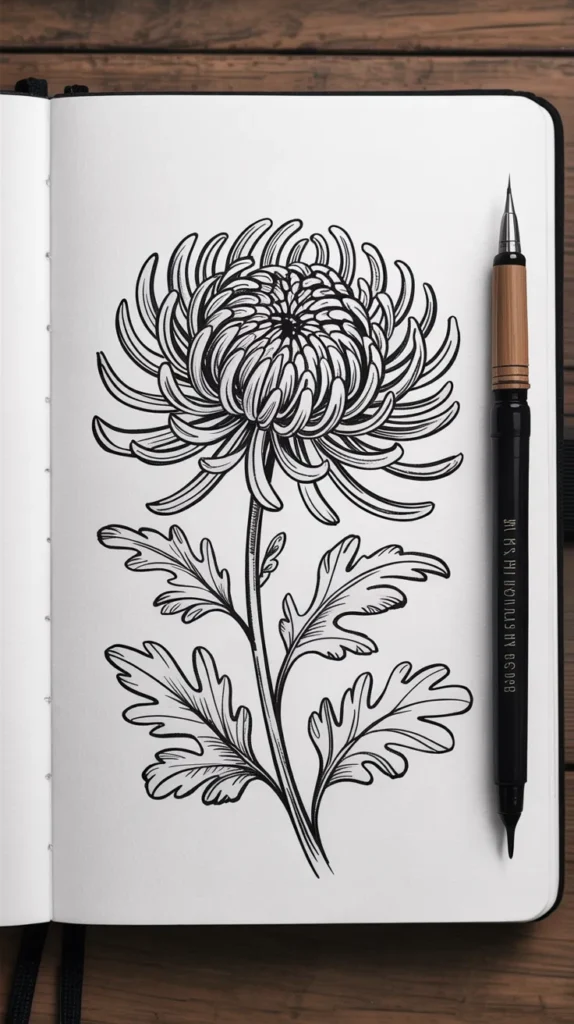
The chrysanthemum is famous for its hundreds of long, thin, often curving petals. A line drawing of a “mum” is an exercise in capturing organized chaos and beautiful, flowing movement.
- How to Draw It: Start from the center and work your way out. The central petals are often shorter and tighter.
As you move outwards, draw longer, curving, S-shaped lines for the petals. Let them overlap and cascade. The goal is not to draw every single petal but to create the feeling of density and flow.
A pen with a flexible brush tip, like the {Tombow Fudenosuke Brush Pen}, is the perfect tool for this, as you can vary your line weight to create dynamic, calligraphic strokes that mimic the petals’ form.
December: The Narcissus (Paperwhite)
Symbolism: Hope, good wishes, wealth.
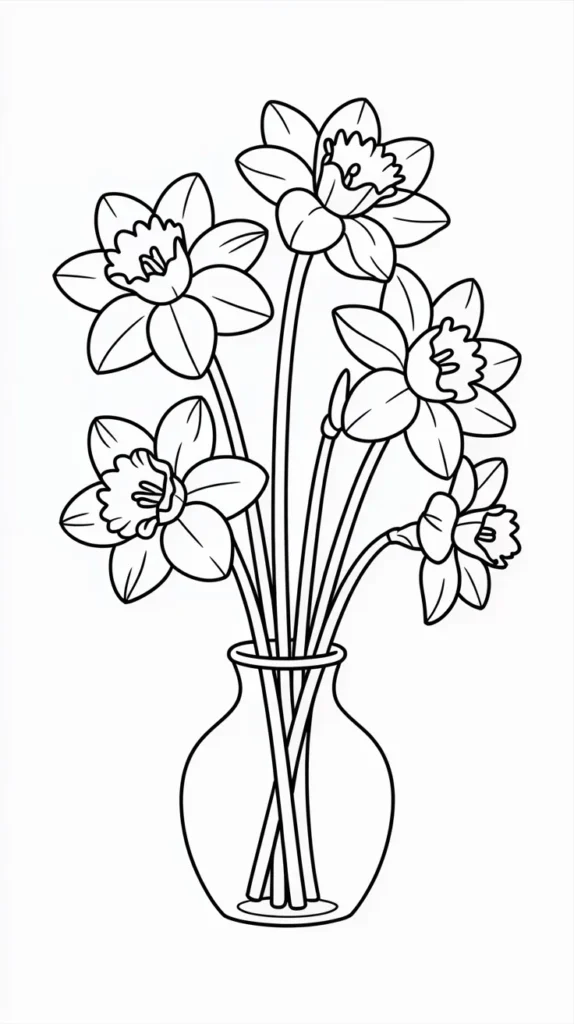
The Paperwhite narcissus is a simple, elegant, star-shaped flower. It has six pointed petals and a very small, shallow central cup. Its simplicity is its strength.
- How to Draw It: Draw the six petals first, arranging them in a star-like pattern. They are typically more pointed than a daffodil’s petals.
In the center, add the small, shallow cup—this can be drawn as a small circle with a slightly wavy edge.
Narcissus often grow in clusters, so drawing a bunch of three or four blooms together on their long, straight stems creates a beautiful and balanced birth flower line drawing.
Recommended Tools for Your Line Drawing Journey
You only need a pen and paper to start, but these quality tools can elevate your experience and your art.
| Product Name | Brand | Why We Recommend It |
|---|---|---|
| {Sakura Pigma Micron Pen Set} | Sakura | The go-to for artists. These pens offer archival, waterproof ink in a variety of precise tip sizes for ultimate control. |
| {Canson XL Series Mix Media Pad} | Canson | A versatile and smooth paper that is perfect for ink, preventing bleeding and allowing for crisp, clean lines. |
| {Derwent Graphic Drawing Pencils} | Derwent | An excellent set of pencils for preliminary sketching. The range of hardnesses allows for light layouts and darker practice sketches. |
| {Uni Pin Fineliner Pen Set} | Uni-ball | Another fantastic set of reliable fine-liners that are great for detailed work and consistent ink flow. |
| {Wacom Intuos Graphics Drawing Tablet} | Wacom | A great entry point into digital line art, offering precision and the freedom to experiment without wasting paper. |
| {Tombow Fudenosuke Brush Pen} | Tombow | Features a flexible brush tip that is perfect for creating expressive, calligraphic lines with varying weights. |
Conclusion
A birth flower line drawing is a beautiful and accessible way to engage with art and nature. It invites you to look closer, to appreciate the simple elegance of form, and to create something that is both personal and universally beautiful.
The quiet focus required for line drawing is a form of mindfulness, a peaceful escape that leaves you with a stunning piece of art.
We hope this journey through the botanical year has inspired you to pick up a pen.
Don’t be afraid to make mistakes; every line is a step in your creative journey. Start with your own birth flower, and see what beautiful, elegant illustrations you can bring to life.
